The HAL repository system has adopted SWORD v2 for remote imports:
Categories
 SWORD
SWORDThe HAL repository system has adopted SWORD v2 for remote imports:
Re-posted from: http://cottagelabs.com/news/swordv2-and-dspace-new-release
We’re pleased to be able to say that in the last month we’ve been working hard to get the new version of the SWORDv2 java library and the related DSpace module which uses it up to release quality, in time for the DSpace 4.0 release which will be very soon.
For DSpace, this means we’ve achieved the following:
If you’re not a DSpace user, though, you can still benefit from the common java library; we’ve now released this properly through the maven central repository, and if you want to build your server environment from it, you can include it in your project as easily as:
    <dependency>
        <groupId>org.swordapp</groupId>
        <artifactId>sword2-server</artifactId>
        <version>1.0</version>
        <type>jar</type>
        <classifier>classes</classifier>
    </dependency>
    <dependency>
        <groupId>org.swordapp</groupId>
        <artifactId>sword2-server</artifactId>
        <version>1.0</version>
        <type>war</type>
    </dependency>
We hope you have fun with the new software. In the mean time, don’t forget that there’s lots of SWORD expertise hanging out on the sword-app-tech mailing list.
Richard Jones, 15th November 2013
Our previous post “SWORDv2 Compliance: what is it and why is it good?” introduced some reasons to make your scholarly systems compliant with SWORDv2, and what that really means. This post covers an approach to achieving SWORDv2 compliance for your particular use case(s), using DataStage and DataBank as examples.
First, if you are implementing a SWORD v2 solution, it’s worth having a passing acquaintance with the specification, at least so you are aware of the standard protocol operations.
An approach that we’ve found works well for designing how to fit SWORD v2 to your workflow is as follows:
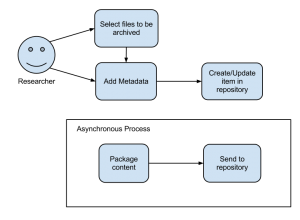
Draw a diagram of your deposit workflow, with all the systems and interactions required. Don’t mention SWORD v2 anywhere at this point; let’s make sure that it meets your workflow requirements, not that you fit your workflow to it.
For example, here’s a basic diagram showing how the DataStage to DataBank deposit looks (click to enlarge):
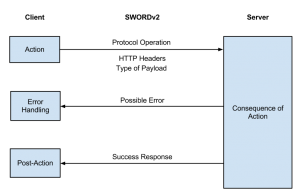
Re-draw the diagram in the following form (click to enlarge):
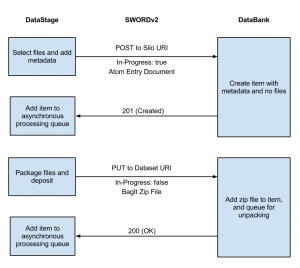
By referring to the spec throughout, you can figure out which SWORD v2 operations with which HTTP headers and what deposit content is required to achieve your workflow. For example, the diagram for DataFlow which integrates DataStage and DataBank looks basically like this (click to enlarge):
Take one of the code libraries (which exist in Python, Ruby, Java and PHP for the client-side, and Java and Python for the server-side), and find the methods which implement the SWORD operations that your diagram tells you that you need.
For example, consider some (simplified) Python code required by DataStage to deposit to DataBank:
# create a Connection object
conn = Connection(service_document_url)

# obtain a silo to deposit to (this just gets the first Silo in the list)
conn.get_service_document()
silo = conn.sd.workspaces[0][1][0]

# construct an Atom Entry document containing the metadata
e = Entry(id=dataset_identifier, title=dataset_title,
             dcterms_abstract=dataset_description)

# issue a create request
receipt = conn.create(col_iri=silo.href, metadata_entry=e)
It should then be a relatively straightforward task for a programmer to integrate this code into your application workflow.
(This is the second part of a two-part article about SWORDv2 compliance. You can read the first part here: SWORDv2 Compliance: what is it and why is it good?)
What does it mean to be compliant, and why is this a good thing? Where are the edges of SWORD v2 (what is part of the standard, what isn’t)? This blog post aims to address these questions.
A compelling reason to comply with SWORD v2 in your environment is that more and more sector-wide infrastructure is already being built using it, and you will be able to take advantage of it easily. SWORD v2 allows content to easily be moved between scholarly systems. For example, Jisc, via the UKRepNet+ project, are working with EuroPMC and Nature Publishing Group to allow the deposit from their publisher systems directly into digital repositories. It is likely that more cross-organisational bodies will utilise SWORD v2 for parts of their infrastructure in the future, and it will be valuable for repositories (and other systems) to be prepared.
From a technical point of view, compliance just means having implemented the parts of SWORD v2 which are required by the specification. It has a lot of optional components, so it is relatively easy for a software implementation to be compliant.
You can also comply with the specification while also extending it for your own needs. Since SWORD v2 is a profile of AtomPub it can take advantage of all of the extension mechanisms it provides. This means that custom metadata (beyond the Dublin Core explicit in the specification), for example, can be embedded into deposit requests.
A more general benefit to being compliant is that any given client/server pair can understand each other. This doesn’t strictly mean that one will be able to deposit to the other, since a successful deposit implies a common understanding of deposit package formats and metadata, which are not issues that SWORD v2 is designed to deal with. What it means instead is that they can mutually determine whether deposit can take place, and carry it out if so.
Another benefit to complying with SWORD v2 is for reduction of overall effort in supporting deposit. Even though there may be work to do in your client or server environment to support the package and metadata formats for your needs, the transport layer itself is well defined and well supported by software libraries and repository systems. Thus the overall implementation effort for a deposit workflow is significantly reduced.
There are three key principles to bear regarding what SWORD v2 is:
There are some things that SWORD v2 does, though, to help out with some of the content related issues. First, it allows you to give your package formats identifiers, which means that a client and server can agree when they support the same format, but the definition of those identifiers is not part of the standard – you can just make them up yourself!
For example, the BagIt format used by DataStage and DataBank is:
http://dataflow.ox.ac.uk/package/DataBankBagIt
Which allows both sides of the deposit to know that they are dealing with a BagIt file of the particular format that they both understand.
Second, it actually does specify a minimum metadata format (Dublin Core) and package format (a simple ZIP file) so that any client/server pair should always be able to transfer binary content, even if they can’t exchange more structured packages or metadata.
Because SWORD v2 is a specification rather than a piece of software, there are a variety of software implementations in different languages for different purposes, and they all have some variations in how they implement the spec. This means, especially as much of that software is new, that sometimes things won’t go as expected. In those cases there are some things that you can do:
(This is the first part of a two-part article about SWORDv2 compliance. You can read the second part here: SWORDv2 Compliance: how to achieve it)
Cottage Labs have written a blog post about their project to add SWORD v2 deposit functionality into the DCC’s DMPOnline tool. This new feature allows data management plans that have been created to then be deposited into a central repository using SWORD v2. By using SWORD v2 (rather than SWORD v1), the data management plans can be re-deposited and updated within the repository as they change.
The code for DMPOnline with Repository Integration is available from: https://github.com/CottageLabs/DMPOnline Cottage Lab’s project page for the project is http://cottagelabs.com/projects/oxforddmponline
This is a bog post detailing some work that the SWORD team (Richard Jones, Stuart Lewis, Pablo de Castro Martin) have undertaken. It describes some work related to research data deposit scenarios.It is hoped that a fuller write-up of this work will be published formally. In addition, a cut down version will be presented at the Open Repositories 2012 conference as a Pecha Kucha session.
Research Data Management (RDM) initiatives are a hot-topic, being driven by factors such as funder and institutional policies, the increasing complexity of dealing with everyday research data, the expectation to be able to perform and share science using collaborative tools such as those available in areas such as social and cloud computing, and the growing popularity of open scholarship. However, although some infrastructures for data management are gradually becoming commonplace, many initiatives remain as yet at a rather embryonic stage.
This post summarises the wide variety of research data transfer processes from a technical point of view as presented in full in our associated paper, with a focus on how a deposit protocol such as SWORD may aid those transfer procedures. It includes a categorisation and description of the data deposit fingerprint concept, specific use cases, technical challenges of implementing these use cases using SWORD v2, and finally highlighting any gaps in the protocol’s abilities.
Each data deposit use case is made up of a number of elements:
The notion of a data deposit fingerprint is the combination of data type, source, target, and future interaction description (the letters by each part above). When put together, the fingerprint describes what is being deposited, how the deposit takes place, and how the data may change in the future.
A selection of the longer list of examples in the main paper
From the above use cases we can extract a broad set of requirements for deposit of research data and associated collateral:
Most of the requirements can be met with SWORDv2 as it is, but some of them cannot. This section picks out requirements where support within SWORD is either lacking or insufficient, and suggests possible approaches.
3. Some clients will need to be able to stream files over a period of time; for example, when a piece of equipment is producing new measurements which need to be streamed to the server (DC)
We must consider the possibility that each new bit of content being streamed by the client is appended to an existing file on the server: this behaviour is currently unsupported in SWORD.
4. The client/server pair must be able to support the deposit of arbitrarily large files (DC)
Because of the need to support large files or deposit-by-reference situations, both of which may require post-processing after the deposit has completed, the standard 201 (Created) response by the server might not be appropriate, and a 202 (Accepted) would be better (along with enhancements to error handling for such deposits), which is not currently available in SWORD. Further, it is unclear whether deposit-by-reference payloads can be considered Packages in the SWORD sense, so some clarification is needed.
8. The client must be able to deliver collection metadata to the server (DCD)
There are no options within SWORD (or Atom) to update the collection metadata.
10. The deposit must be possible from a person who is the originator/custodian of the data (PC, CRIS)
While it is clear in the SWORD specification that authentication and authorisation are covered (Section 8), it is worth noting that the profile says nothing about alternative authentication and authorisation mechanisms such as OAuth.
13. Sometimes objects will need to be delivered to multiple destinations. Therefore the client must be able to deliver the same item to multiple locations. (R, P)
and
14. Sometimes one part of an object will need to be sent to one location, and another part to a different location (for example, data to one location, metadata to another). Therefore, the client must be able to deliver different parts to different places, also taking into account (13). (CRIS, P)
Is there anything that SWORD can do to support the multiple-deposit-target requirement, such that it is easier for multi-depositing client environments to operate?
15. If different parts of the object go to different locations (e.g. data and metadata) as per (14), it should be possible for each location to know about the other(s). (CRIS, P)
and
16. Further to (15), it should be possible to update an aspect of the object (e.g. the dataset or the metadata) with information regarding a related part of the object or a related work (e.g. the dataset associated with some metadata, or the publication derived from the data). (CRIS, P)
The main issue lacking with SWORD for this requirement is clarity in the mechanism by which items on servers know about other items which are either equivalents or additional closely related materials (e.g. the data and the associated metadata in two separate locations).
17. Sometimes it will be necessary to bulk transfer data between systems, so the protocol should support bulk transfer and data migration. (R, IR, IDR, SS)
Although SWORD doesn’t technically prevent bulk transfer, we should consider options which would make this process easier.
18. In some cases the deposit repository will be a staging environment for the data pending migration (as per (17)). The client should be able to discover when a server has migrated the data. (R).
Where data is moved after deposit, the client will need a way to discover the new Edit-IRI. The server can use a 303 (See Other) response which the profile permits although does not explicitly cover, nor does it mention any other details around performing an HTTP GET on the Edit-IRI which could clarify such situations.
19. It must be possible for the depositor to select an appropriate deposit target, both the repository itself and the collection within the repository (IR, IDR, GR, SR, PRR, TSS, UDR, SS)
Although SWORD uses Service Documents so that clients can discover deposit targets within a repository, it does not include anything for discovery of repositories, and it is worth exploring whether there is anything that SWORD could do to improve the discovery options.
Originally published at: http://isc.ukoln.ac.uk/2012/03/20/launch-of-sword-version-2/
The second version of the SWORD resource deposit protocol, designed primarily to enable the deposit of scholarly works into content repositories, has now been released. Developed with funding from the JISC, the SWORD v2 project has built upon the successful and award winning SWORD deposit protocol to now support the full deposit lifecycle of deposit, update, and deletion of resources. In addition of the new technical standard, implementations for some of the most well-known repository platforms have been created, along with client toolkits and exemplar demonstrators.
Led by Richard Jones (Technical Lead) of Cottage Labs and Stuart Lewis (Community Manager), formerly of the University of Auckland, now of the University of Edinburgh along with oversight from Paul Walk from the UKOLN Innovation Support Centre, the project was steered by an international technical advisory group of 36 experts in the areas of repositories, standards development, and scholarly content.
The development of the standard will allow a new breed of smart deposit scenarios and software products that are able to deposit content into one or more repositories, track the deposits over time, interact with them and update, or remove them. Before SWORDv2, deposit interoperability took the form of single deposits, coined as ‘fire and forget’. Once a deposit had been made, no further interaction was possible. SWORD v2 extends its support for the Atom Publishing Protocol (AtomPub) by adding support updates and deletions. These will enable new interoperable deposit management systems to be built that will work with any SWORD v2 compliant system.
Deposit use cases which are now possible include collaborative authoring, or getting more integrated with the publication workflow where multiple updates and versions of documents are required. Further details can be found at the SWORD website: https://sword.cottagelabs.com/ or by emailing info@swordapp.org
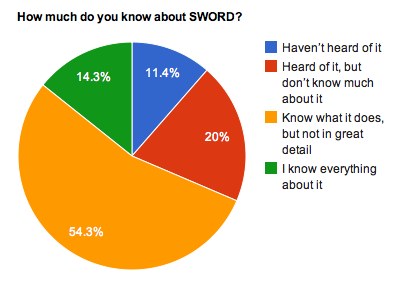
We recently posted a survey about ‘Data Deposit’. The survey is still open if you wish to respond.
The first question in the survey asks:
The SWORD v2 project has been asked by the JISC to look into the applicability of the SWORD protocol for depositing Research Data. The SWORD protocol has always been agnostic about the type of resource it is depositing, however its initial development stemmed from a requirement for the deposit of scholarly communications outputs into repositories – these typically being small text-based items.
In order to investigate how well SWORD and SWORD v2 would deal with Research Data, we need to know about the different types of research data that you are working with. This will allow us to discover some of the range of different data types in use, and the general and specific requirements of each.
We’ve tried to keep the survey short – it is only 9 questions long. If you have a few minutes to share some information with us about the data you work with, we would very much appreciate it.
Visit the survey at https://sword.cottagelabs.com/sword-v2/sword-v2-data-deposit-survey/
As part of the SWORD v2 project finding, resources were allocated to implement it in a number of repository platforms. First off the block to release SWORD v2 implementations as part of their core functionality are EPrints and DSpace: